Best Grow Lights for Indoor Herbs: Complete Beginner Guide
If your indoor herbs keep becoming pale, leggy, or weak, the real problem is often insufficient light. Many kitchen herb plants like basil, parsley, and cilantro evolved in sunny regions where they receive strong natural sunlight for most of the day.
Inside homes and apartments, however, sunlight is often limited. Windows may face the wrong direction, buildings block light, or winter days simply aren’t bright enough.
This is where grow lights become extremely helpful.
This guide explains what grow lights are, how they work, which type is best for herbs, and how to set them up correctly.
If you’re not sure whether your space qualifies as low light, use our herb growing quiz tool to find the best match.
What Are Grow Lights?
Grow lights are artificial lighting systems designed to support plant growth indoors. Unlike normal household bulbs, grow lights produce the light spectrum plants use for photosynthesis.
Plants absorb light using a pigment called chlorophyll, which plays a central role in photosynthesis. This pigment responds to specific wavelengths of light, mainly in the blue and red parts of the spectrum.
Good grow lights provide what scientists call Photosynthetically Active Radiation (PAR) — the range of light wavelengths plants use for energy.
In simple terms, grow lights act as artificial sunlight that replaces or supplements natural light indoors.
They allow plants to grow in places where natural sunlight is limited, such as:
- apartments
- kitchens
- basements
- offices
- indoor shelves
For indoor herb gardening, grow lights can dramatically improve plant health.
Why Plants Respond Differently to Artificial Light
Even though grow lights are designed to mimic sunlight, plants don’t react to them exactly the same way.
Natural sunlight changes throughout the day in intensity and angle. Grow lights stay constant.
Because of this, plants under artificial light often grow:
- more evenly
- more predictably
- with less directional leaning
This consistency is one of the main advantages of indoor lighting setups.
Why Indoor Herbs Often Struggle Without Enough Light
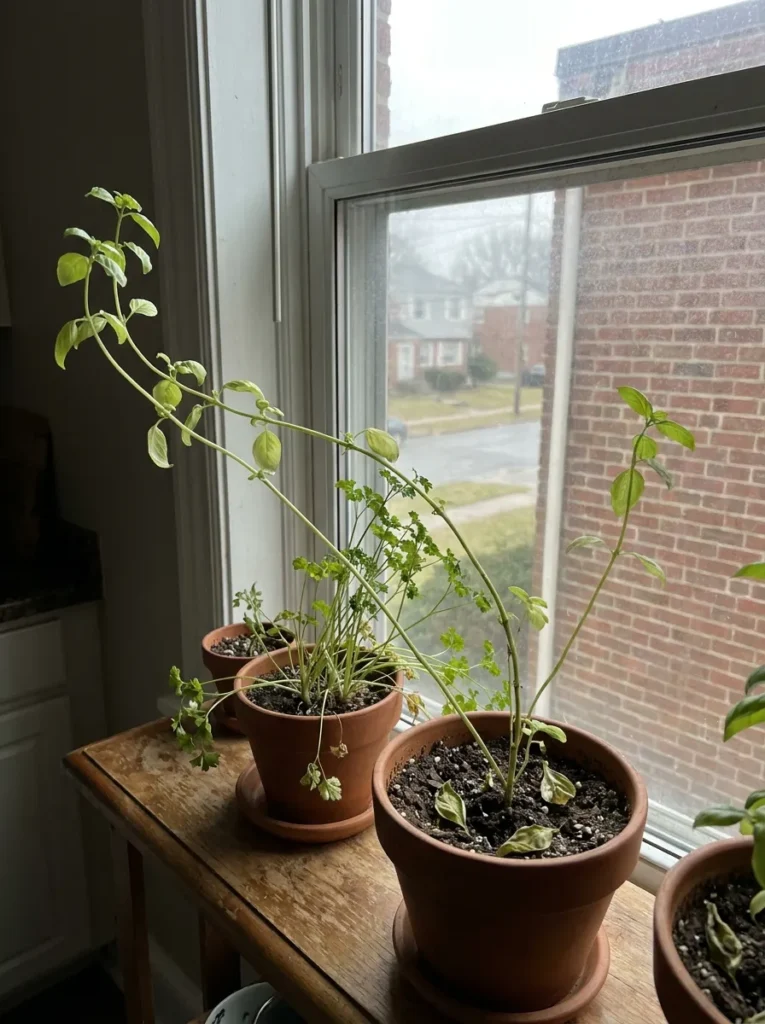
Many beginners assume that placing herbs near a window is enough. Unfortunately, indoor lighting is often weaker than it looks.
When herbs don’t receive enough light, they start showing clear signs:
- stems become long and thin
- leaves turn pale green
- plants grow slowly
- flavor becomes weaker
- leaves droop or fall
This stretching behavior is called etiolation. Plants stretch toward light because they are trying to capture more energy.
Types of Grow Lights for Indoor Herbs
Not all grow lights are the same. Different technologies produce light differently, and some are better suited for herbs than others.
1. LED Grow Lights
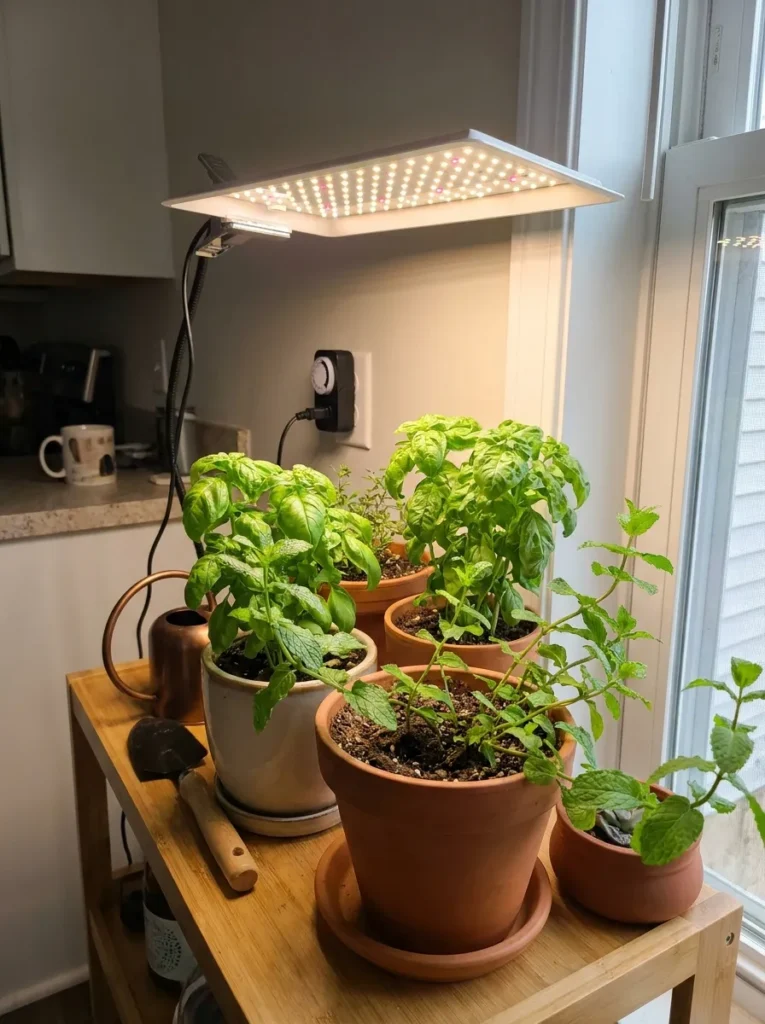
LED stands for Light Emitting Diode.
LED grow lights are currently the most popular option for indoor herb gardens because they are efficient, long-lasting, and produce very little heat.
They convert electricity into light very efficiently, meaning less energy is wasted as heat.
Advantages of LED Grow Lights
- very energy efficient
- low heat production
- long lifespan (often 30,000–50,000 hours)
- compact design
- full spectrum options available
LED lights work especially well for leafy herbs such as:
- basil
- mint
- parsley
- cilantro
- oregano
- thyme
Sub-Types of LED Grow Lights
There are several LED formats available, each suited for different indoor setups.
1. LED Grow Light Panels
These are flat panels containing many small LEDs.
They provide strong, evenly distributed light, making them ideal for:
- indoor herb shelves
- plant racks
- larger herb gardens
They typically hang above plants and illuminate a wider growing area.
2. LED Grow Light Bulbs
These bulbs fit into normal light sockets.
They are one of the simplest options for beginners.
Advantages include:
- easy installation
- affordable
- suitable for small herb gardens
They work well in desk lamps or clamp lights positioned above plants.
3. LED Strip Grow Lights
LED strips are long, narrow light bars often installed under shelves.
They are perfect for multi-level herb gardens.
Benefits include:
- evenly distributed light
- slim design
- ideal for plant shelves
Many indoor gardeners use these strips for kitchen herb racks.
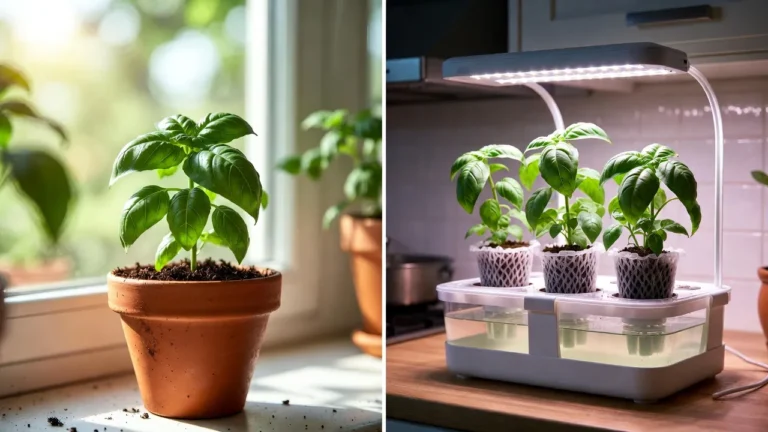
4. Clip-On LED Grow Lights
Clip-on lights attach directly to shelves, desks, or windowsills.
They are popular for small herb collections because they require minimal setup.
These lights are especially useful for:
- apartment herb gardens
- windowsill plants
- kitchen counters
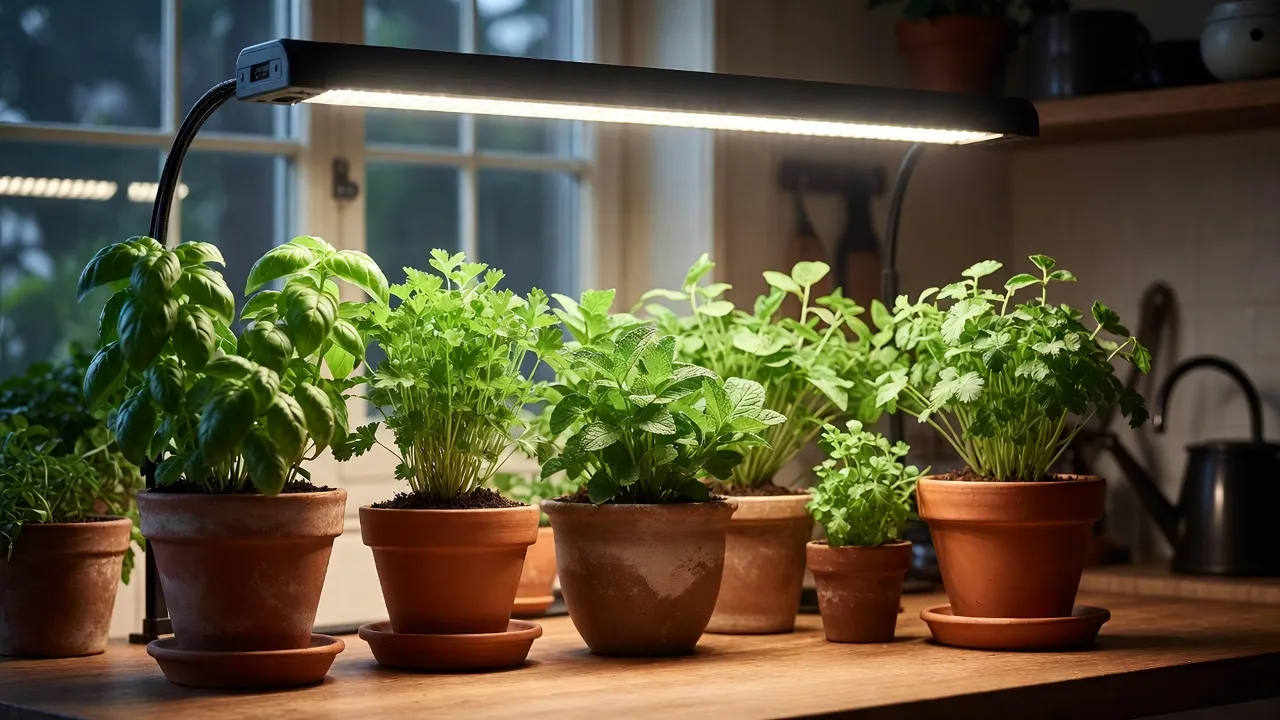
5. LED Grow Lamps with Adjustable Arms
These lights resemble desk lamps but contain grow light LEDs.
They allow users to adjust height and angle easily, making them suitable for growing herbs individually.
Why LED Lights Stay Cool Compared to Other Lights
LED lights convert most of their energy into usable light instead of heat.
Older lighting systems release a large portion of energy as heat, which can warm the surrounding air and dry out plants faster.
With LEDs:
- leaf temperature stays more stable
- soil moisture changes more slowly
- plants experience less stress
This makes them easier to manage in small indoor spaces.
2. Fluorescent Grow Lights
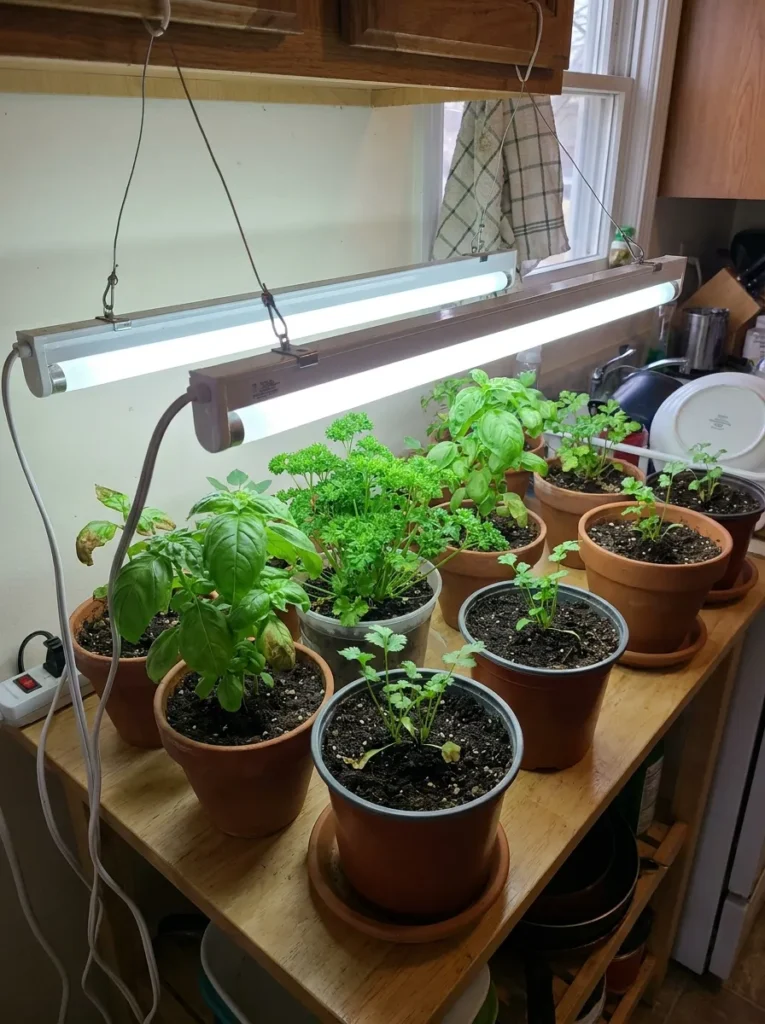
Fluorescent lighting has been used for indoor gardening for decades.
These lights use gas-filled tubes that emit light when electricity passes through the gas inside the tube.
They are less efficient than LED lights, but still work well for herbs.
Benefits of Fluorescent Lights
- affordable
- widely available
- gentle heat output
- good for leafy plants
Sub-Types of Fluorescent Grow Lights
1. T5 Fluorescent Tubes
T5 lights are thin fluorescent tubes commonly used in indoor gardening.
They produce bright light and are often used for:
- seedlings
- herb gardens
- plant shelves
They are especially effective when placed close to plants.
2. T8 Fluorescent Lights
T8 tubes are slightly larger and less intense than T5 lights.
They are commonly used in office lighting but can also support plant growth.
They work best when placed close to herbs.
3. Compact Fluorescent Lamps (CFL)
CFL bulbs are spiral-shaped bulbs that fit standard sockets.
These are simple options for small herb gardens.
Advantages include:
- inexpensive
- easy to install
- good for one or two plants
However, they are less efficient than LED lighting.
Fluorescent lights don’t produce as intense light as LEDs. Because of this, they need to be placed closer to the plants to be effective.
If they are too far away:
- plants may stretch
- growth slows
- leaves become pale
Keeping them close helps maintain enough light intensity for healthy growth.
3. HID Grow Lights
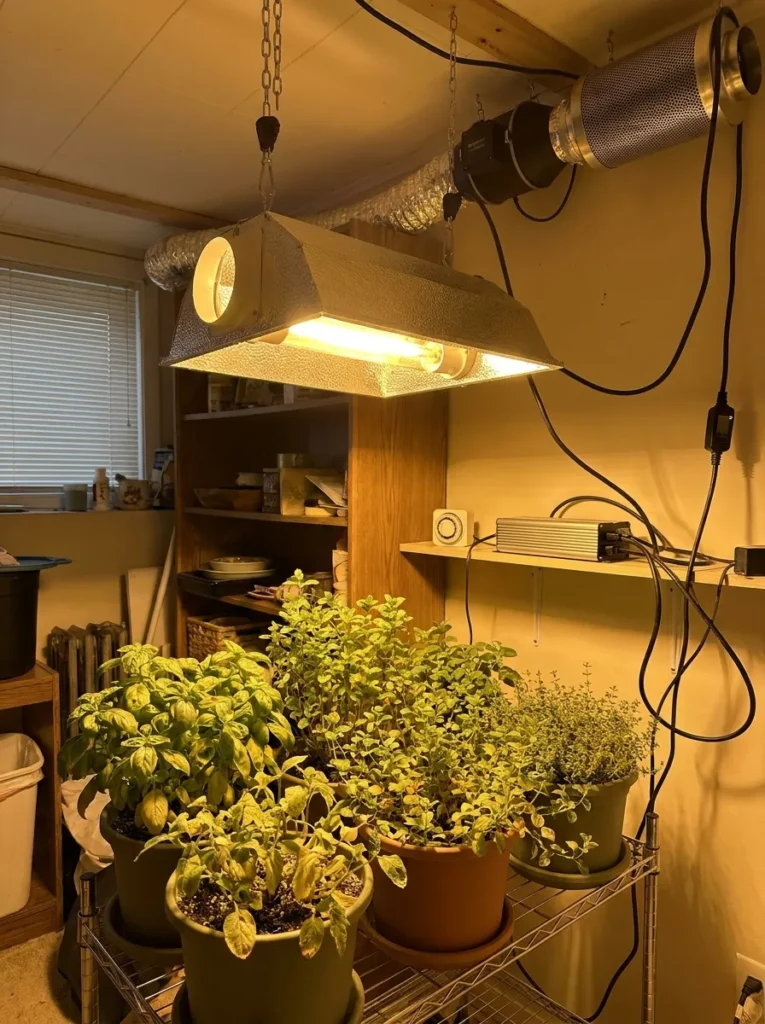
HID stands for High Intensity Discharge lighting.
These lights produce extremely bright illumination and are often used in commercial indoor farms or greenhouses.
For small indoor herb gardens, they are usually unnecessary.
Sub-Types of HID Lights
Metal Halide (MH)
Metal halide lights produce strong blue-spectrum light.
They are often used during the vegetative growth stage of plants.
However, they generate significant heat.
High Pressure Sodium (HPS)
HPS lights produce strong red-spectrum light.
They are often used for flowering plants in commercial growing systems.
They also produce significant heat and require ventilation.
Why HID Lights Are Rarely Used for Herbs
Although powerful, HID lights have disadvantages:
- high energy consumption
- large equipment size
- strong heat production
For small herb gardens, LED or fluorescent lighting is far more practical.
4. Incandescent Grow Lights (Not Recommended)
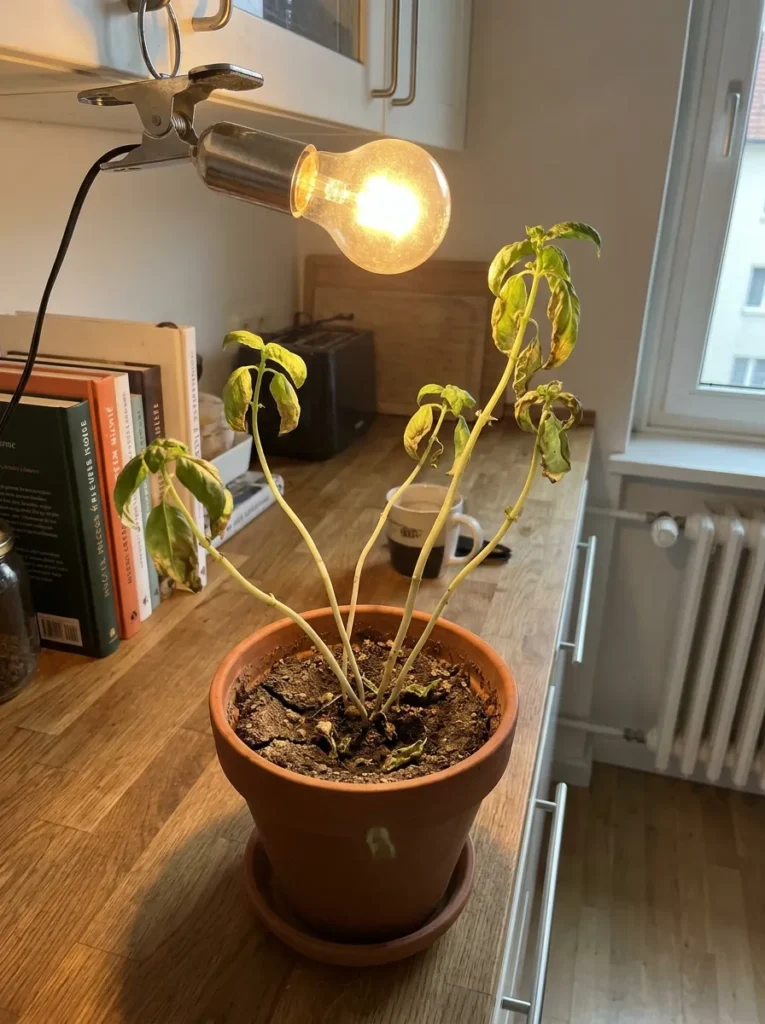
Incandescent bulbs are traditional household light bulbs.
They are not ideal for plant growth because:
- they produce mostly heat instead of usable light
- they lack the correct plant spectrum
- they waste energy
They are rarely used in modern indoor gardening.
LED vs Fluorescent Grow Lights
Feature | LED Lights | Fluorescent Lights |
|---|---|---|
Energy efficiency | Very high | Moderate |
Heat output | Low | Low |
Lifespan | 30k–50k hours | 8k–15k hours |
Upfront cost | Higher | Lower |
Maintenance | Minimal | Tubes need replacement |
For most indoor herb gardeners, LED grow lights are the easiest and most efficient choice.
Understanding Light Spectrum for Plant Growth
In addition to choosing the right type of grow light, understanding how plants use different wavelengths of light can help gardeners optimize plant growth.
Plants use light differently than humans do. While we see white light, plants respond to specific wavelengths within that light.
Two main parts of the plant spectrum are especially important.
Blue Light
Blue light supports vegetative growth.
It encourages:
- leaf development
- strong stems
- compact plant structure
Leafy herbs respond well to blue light because their main purpose is producing foliage.
Red Light
Red light plays a role in plant development and flowering. It helps plants regulate growth cycles.
Full Spectrum Light
Most modern grow lights provide full spectrum light, which includes both blue and red wavelengths along with other parts of the spectrum.
Full spectrum lights mimic natural sunlight and support balanced plant growth.
Important wavelength ranges include:
Light Type | Function |
|---|---|
Blue light (400–500 nm) | promotes leaf growth |
Red light (600–700 nm) | supports plant development |
Full spectrum | mimics natural sunlight |
Most indoor herb gardeners prefer full-spectrum grow lights, because they support healthy leaf growth and balanced plant development.
Once the correct light spectrum is provided, the next important factor is the duration of light exposure each day.
How Much Light Indoor Herbs Need
Most herbs require 12 to 16 hours of light per day to grow well indoors.
The exact requirement depends on the herb species.
Herb | Light Needed Per Day |
|---|---|
Basil | 14–16 hours |
Mint | 12–14 hours |
Parsley | 12–14 hours |
Cilantro | 12–14 hours |
Thyme | 12–14 hours |
Oregano | 12–14 hours |
Even when using artificial lighting, herbs still benefit from a dark period at night. Plants use darkness to regulate biological processes.
A simple light timer can automate this schedule.
Why More Light Isn’t Always Better
It might seem like keeping lights on longer would improve growth.
In reality, plants need a rest period. During darkness, plants carry out internal processes that support growth and energy balance.
Too much light without a break can:
- disrupt natural cycles
- slow overall development
- stress the plant
A consistent cycle is more important than maximum exposure.
How Far Should Grow Lights Be From Herbs?
The distance between the light and the plant is extremely important.
If the light is too far away, plants stretch and become weak. If it is too close, leaves can burn.
General guidelines:
Light Type | Distance from Plants |
|---|---|
LED grow lights | 6–12 inches |
Fluorescent lights | 4–8 inches |
Adjusting light height as plants grow keeps lighting consistent.
How to Tell If Light Distance Is Correct
Instead of relying only on measurements, you can observe the plant.
If the light is positioned well, you’ll see:
- compact, upright growth
- evenly spaced leaves
- consistent color
If the light is too far:
- stems stretch
- leaves become smaller
If it’s too close:
- leaf edges may dry or curl
Plants usually show clear signals within a few days.
How to Set Up Grow Lights for Indoor Herbs
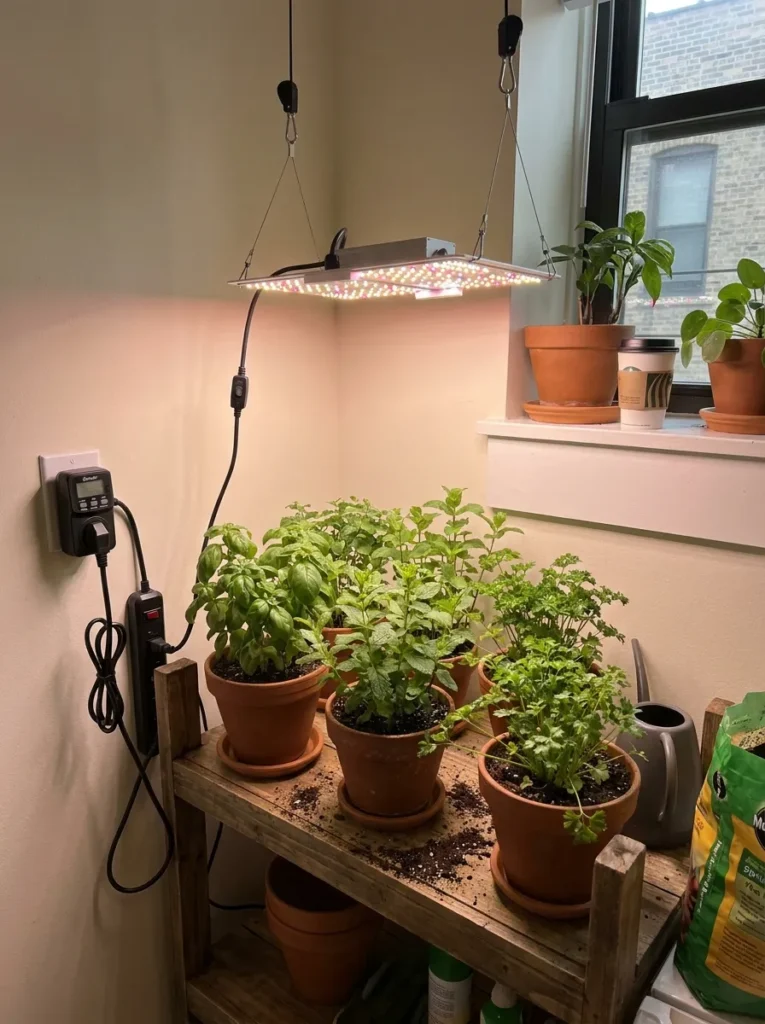
Setting up grow lights is easier than many people expect.
Step 1: Choose a Location
Select a place where herbs will grow comfortably, such as:
- kitchen counters
- windowsills
- indoor plant racks
- shelves
Ensure the area has good air circulation.
Lighting works best when herbs are planted in containers that allow proper drainage and root growth. If you’re unsure which pots work best indoors, this guide on choosing the right containers for indoor herbs explains the most suitable container types for kitchen herb gardens.
Step 2: Install the Grow Light
Mount the light directly above the plants. Overhead lighting distributes illumination more evenly than side lighting.
Many people use:
- clip-on lights
- hanging grow lamps
- LED bars under shelves
Step 3: Adjust the Height
Position the light at the recommended distance from the plant canopy.
As herbs grow taller, raise the light slightly to maintain the correct spacing.
Step 4: Set the Light Schedule
Use a timer to create a consistent schedule.
A common routine is:
14 hours of light followed by 10 hours of darkness.
Consistency helps plants maintain healthy growth cycles.
Step 5: Monitor Plant Growth
Healthy herbs growing under good lighting will show:
- deep green leaves
- compact growth
- steady new shoots
If plants stretch or look pale, the light intensity may be too low.
If your herbs suddenly develop spots, sticky leaves, or tiny insects, pests may be responsible. This guide on common indoor herb pests and how to remove them naturally explains how to identify and treat these problems.
Indoor Herb Lighting Setups
Different homes require different lighting setups.
Kitchen Counter Herb Garden
Small LED lamps or compact panels work well on kitchen counters. These lights provide targeted illumination without taking up much space.
Windowsill Herb Garden
Even sunny windows sometimes need extra light during winter. Clip-on LED lights can supplement natural sunlight.
Shelf Herb Garden
For multi-level herb gardens, LED strip lights installed under shelves provide consistent lighting to every plant.
Indoor Herb Stations
Some indoor gardeners create dedicated herb stations using:
- plant racks
- grow shelves
- reflective surfaces
- overhead grow lights
Reflective materials help distribute light more evenly across plants.
Once your lighting setup is ready, you can apply it practically by following this 60-day indoor herb challenge that guides you week by week.
Electricity Cost of Grow Lights
In addition to plant health, many indoor gardeners also wonder about electricity costs.
In reality, modern LED grow lights are very efficient.
For example:
A 20-watt LED grow light running 14 hours per day uses about 0.28 kilowatt hours daily.
In many regions, this equals only a few dollars per month in electricity.
Fluorescent lights consume slightly more power but are still relatively affordable.
Common Grow Light Mistakes
Even with good lighting equipment, a few mistakes can affect plant growth.
Placing Lights Too Far Away
When lights are too far above plants, herbs stretch toward the light and become weak.
Using Decorative Lamps Instead of Grow Lights
Regular desk lamps often lack the PAR spectrum plants need for photosynthesis.
Not Providing Enough Light Hours
Herbs require long photoperiods. Eight hours of light is usually not enough.
Ignoring Heat
Some lights produce heat that dries soil quickly. Monitoring plant temperature helps avoid stress.
Forgetting Darkness
Plants need a night period to regulate biological processes. Continuous light can disrupt growth.
Lighting problems are just one part of indoor herb care. Many beginners unknowingly make several small mistakes that affect plant growth. This guide on common indoor herb gardening mistakes and how to fix them explains the most frequent issues indoor gardeners encounter.
Best Herbs to Grow Under Grow Lights
With proper lighting in place, many common culinary herbs thrive indoors under artificial light.
Popular choices include:
- basil
- mint
- parsley
- cilantro
- chives
- thyme
- oregano
- dill
These herbs produce leafy growth, which responds well to consistent lighting.
Once your herbs begin producing healthy leaves under grow lights, harvesting them properly becomes important. Learning how to harvest indoor herbs without killing the plant ensure fresh leaves throughout the season.
Signs Your Grow Lights Are Working Properly
Healthy herbs growing under proper lighting usually show several positive signs:
• deep green leaves
• steady new growth
• compact plant structure
• stronger aroma and flavor
Can Herbs Grow Without Grow Lights?
Yes, herbs can grow without grow lights if they receive enough sunlight.
A south-facing window with several hours of strong light may support herb growth.
However, many indoor environments simply do not provide sufficient sunlight, especially during winter months.
Grow lights act as a reliable backup that ensures herbs receive consistent lighting every day.
FAQs
1. What is the best grow light for indoor herbs?
Full spectrum LED grow lights are widely considered the best option. They mimic natural sunlight, produce minimal heat, and use very little electricity while supporting healthy herb growth.
Do herbs really need grow lights indoors?
Herbs need strong light to grow properly. If natural sunlight is limited, grow lights help provide the energy plants need for photosynthesis and healthy leaf production.
3. How long should grow lights stay on for herbs?
Most indoor herbs need 12 to 16 hours of light per day. After that, they should receive several hours of darkness to maintain normal plant growth cycles.
4. Can basil grow under LED lights?
Yes. Basil grows very well under full spectrum LED lights. Keeping the light about 6–10 inches above the plant helps maintain compact growth.
5. Are grow lights safe to use in kitchens?
Yes. Modern LED grow lights produce very little heat and are generally safe to use in kitchen herb gardens.
6. How strong should grow lights be for herbs?
Small indoor herb gardens usually only need 10–40 watt LED grow lights depending on the number of plants and the size of the growing area.
7. Do herbs need darkness at night?
Yes. Herbs benefit from a dark period each day. Darkness helps plants regulate metabolic processes and maintain balanced growth.
Conclusion
Growing herbs indoors can be incredibly rewarding, but lighting is often the key factor that determines success. Without enough light, even well-watered plants struggle to grow properly.
Grow lights solve this problem by providing the plant spectrum needed for photosynthesis, allowing herbs to thrive even in apartments or homes with limited sunlight.
For most indoor gardeners, full spectrum LED grow lights offer the best balance of efficiency, low heat, and strong plant growth.
With the right lighting setup, a small collection of herbs on a windowsill, kitchen counter, or shelf can become a productive indoor garden that provides fresh flavor all year long.
If you’re planning to build your herb garden from scratch, understanding the complete setup makes the process much easier. This beginner-friendly guide on how to start an indoor herb garden step-by-step walks through everything you need to begin.

Hi, I’m Rimsha, founder of Urban Bloomer 🌱
I grow herbs and plants in a small apartment and share what actually works in limited indoor spaces. Over the past few years, I’ve tested different setups, from lighting and soil to watering routines, to find simple methods that make indoor gardening easier.
Here, you’ll find practical, beginner-friendly advice based on real experience, not complicated gardening systems.